
Press-on nails are one of the fastest-growing beauty exports from China. As a Shenzhen-based freight forwarder, we work with many nail trading companies and nail factories across China — moving their products to brands, wholesalers and Amazon sellers in the USA and Europe every week. We spend a lot of time on the factory floor: checking cartons, watching containers being loaded, and understanding exactly how these tiny products are made.
This article takes you inside a press-on nail factory, step by step — and explains what each stage means for importers and for shipping.
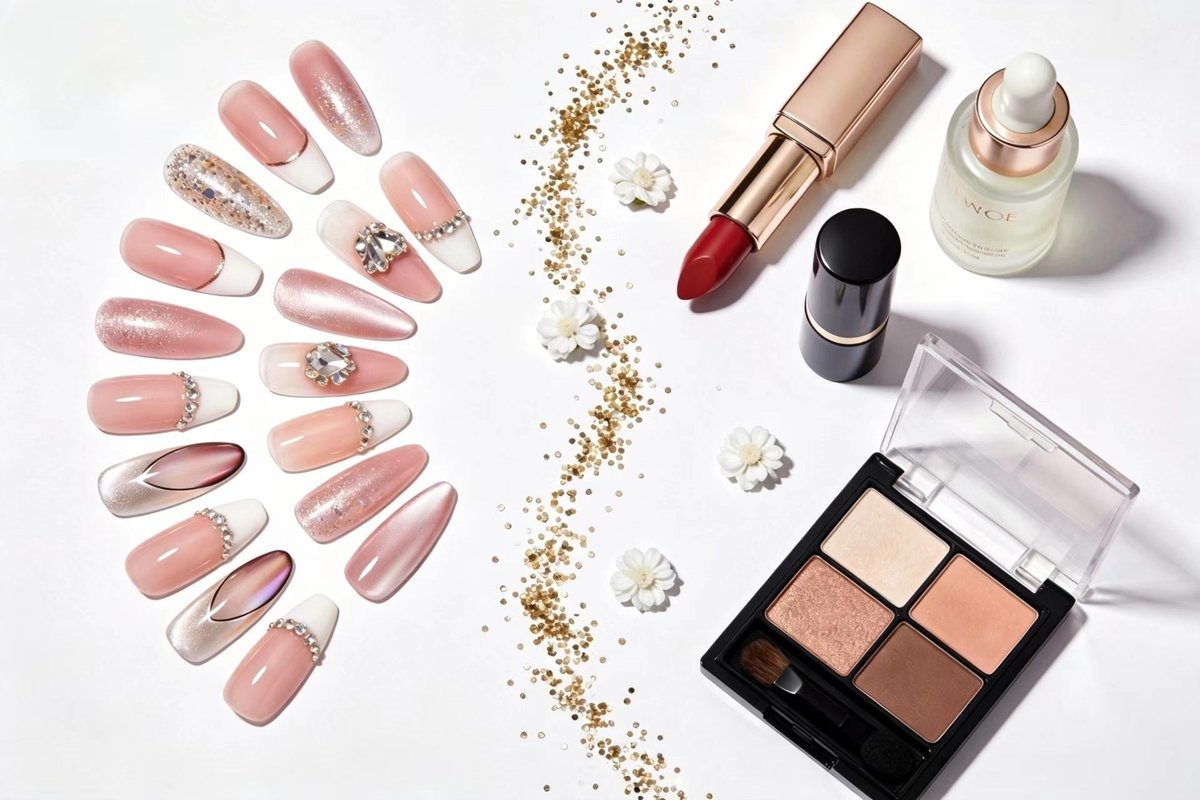
Modern Factories, Advanced Processes
If your picture of a Chinese nail factory is a small workshop with a few workers, it is out of date. The factories we work with today are modern manufacturing plants — and that is a big part of why China dominates the global press-on nail market.
- Automated injection lines — computer-controlled machines run thousands of cycles a day with consistent wall thickness and curve.
- High-precision steel molds — in-house mold shops cut new shapes in days, so a new style can go from idea to production very quickly.
- UV & digital printing — complex artwork, gradients, chrome and personalised designs are printed at production speed, not painted one by one.
- Dust-controlled coating rooms — gel, matte and glitter finishes are applied in clean, temperature-controlled areas for a consistent surface.
- Automated QC and sorting — camera inspection and mechanical sorting catch defects before a single set is packed.
The result: factories that release new collections every few weeks, keep quality stable across large orders, and still price competitively. That speed is exactly why nail brands restock so often — and why logistics has to keep up.
▶Watch: Inside the Factory
1Design & Molds
Everything starts with the shape. New collections are designed as digital mock-ups, then turned into steel molds for each nail size (typically 10–12 sizes per set, from thumb to pinky). A factory may keep hundreds of molds on the shelf — that is why a press-on nail supplier can offer dozens of shapes: short almond, long coffin, square, stiletto, and so on.
2Injection Molding
Plastic pellets — usually ABS, chosen for its strength and light weight — are heated and injected into those molds. Seconds later, the machine opens and a sprue of nail tips comes out. The tips are separated, and the edges are trimmed and polished by machine or by hand. At this stage the nails are still blank: a shape, no design.
3Printing & Coating
This is where a blank tip becomes a product. Designs are printed onto the surface — decals, UV printing, or pad printing — and then a coating is applied: gel, matte, glitter, chrome, or French tips. Some designs are hand-painted in small batches, which is why limited collections sell out so quickly.
Coatings and adhesives are the reason nail products need attention at export: polish, gel, glue and remover can contain solvents such as acetone (UN1090), which are classified as dangerous goods. A forwarder who does not understand this will either refuse the shipment or put it on the wrong lane — and delay your whole order.
4Curing & Quality Control
Coated nails pass through curing (UV or air-drying), then quality control: colour consistency, thickness, curve, and adhesion of the design. Rejects are pulled out by hand. At the end of the line, sets are sorted into the size combinations customers expect.
5Packing & Kitting
The finished nails are packed into blister trays or boxes, usually together with a prep pad, glue or jelly tabs, and a mini file. For e-commerce brands, this is also where barcodes, poly bags, retail boxes and custom labels are applied — the same stage where Amazon FBA requirements (labelling, carton marks, palletizing) decide whether your goods walk into the warehouse or sit at the dock.
What This Means for Importers
Because we see the factory floor every week, we can tell you what to plan for before you book:
- DG awareness — glue, polish and remover may be dangerous goods (acetone is UN1090). We check the MSDS and route the cargo correctly instead of hiding it in a general booking.
- Small-volume, high-frequency — most nail brands restock often. Air express to FBA, air consolidation, and weekly sea LCL/FCL are all on the table; we will compare them against your sell-through.
- Packing protection — nail tips crack, liquids leak. We advise on cartons, inner protection and palletizing before the goods leave the factory.
- Door-to-door options — DDP for the US and Europe, Amazon FBA delivery, and customs clearance handled by us, so your team does not deal with paperwork.
Frequently Asked Questions
Can you ship nail polish and nail glue?
Yes. Nail products containing solvents are usually classified as dangerous goods (for example, acetone is UN1090). We handle the DG documents, packing requirements and carrier booking so the shipment moves legally and predictably.
How long does it take from China to the USA?
Air express to a US FBA warehouse typically takes 5–10 days door-to-door; sea freight takes roughly 25–35 days to the West Coast and 30–40 days to the East Coast, plus trucking. We will recommend the mix that fits your stock cycle.
Do you handle Amazon FBA labelling?
Yes — FNSKU labelling, carton marks, palletizing and appointment booking can all be arranged at our warehouse or at the factory before shipping.
Shipping nail products from China?
Tell us your product, quantity and destination — you will get a workable solution within 12 hours.
Get a Free Quote